Introducing anzel: An AI Knowledge Base for Sports Organizations
What anzel is, the problem it solves for clubs, leagues and investors, and how a shared knowledge layer plus specialized AI assistants turn scattered club data into finished work.
 Elyor Djalalov
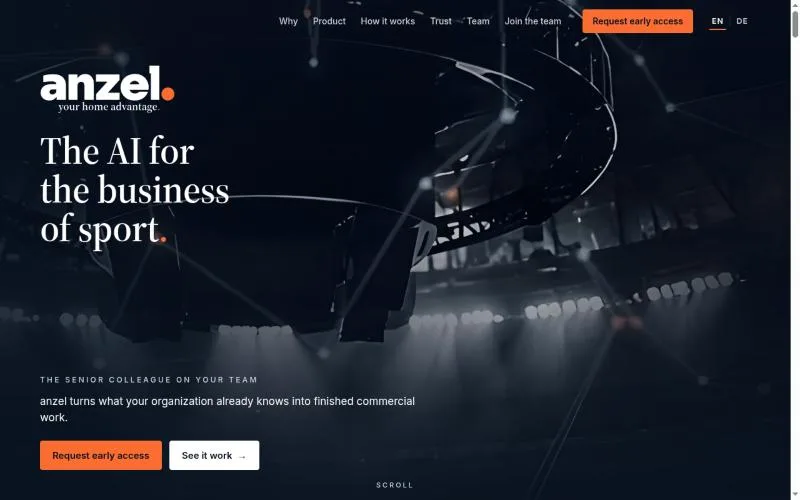
These days I am working on anzel, an AI platform for the business side of sport. This post is a short introduction: what it is, who it is for, and why I think it is an interesting engineering problem.
The Problem: Club Knowledge Lives Everywhere
A sports club is a business as much as a team. Behind every match there is a commercial operation: sponsorships, partner renewals, ticketing, hospitality, media rights, board reporting.
The interesting thing is that most of the information needed to do this work already exists. It sits in:
- signed partner contracts and old proposals
- CRM exports and spreadsheets with a dozen tabs
- season reports and activation trackers
- audience and viewing figures
- email threads, and the heads of a few experienced people
Every season the same jobs come around again, like a sponsor renewal, a rights tender or a partner ROI report, and each one starts with hours of digging through those sources. When an experienced person leaves, a large part of that knowledge leaves with them.
What anzel Does
anzel takes what a sports organization already knows and makes it one structured, shared knowledge base, then puts AI on top of it.
1. A knowledge base the whole club can use
Rights, sponsors, inventory, audiences, past deals, and how they relate to each other are organized into a knowledge layer built specifically for sport. Instead of knowledge living with whoever happened to work on the last deal, every member of the club can access it, within the permissions their role allows.
2. AI insights and finished work
On top of the knowledge layer sit specialized AI assistants (in anzel they are called anzels) for jobs like sponsorship, renewals, pricing and planning. You brief them like a colleague:
“Draft the renewal case for our shirt sponsor. Their contract ends next June.”
The assistant reads the relevant contracts, reports and activation data, then asks the clarifying questions that actually matter. It returns a finished document rather than a chat answer, with facts, assumptions, open questions and sources clearly separated. A person still makes every decision. anzel does the gathering and drafting.
3. One data layer, several audiences
The same knowledge serves different people in the sports ecosystem:
| Audience | What they get |
|---|---|
| Clubs | A single source of truth for their commercial data, plus AI that turns it into renewals, pitches, pricing reviews and board papers |
| Club members and staff | Access to the club’s knowledge base without having to know which spreadsheet or which colleague holds the answer |
| Leagues | A structured view of data across the clubs in the country, useful for rights tenders, benchmarking and planning |
| Investors | Reliable, consistent data about clubs and their commercial performance to inform decisions |
Trust Is a Feature, Not a Footnote
Commercial knowledge is what sets one club apart from another, so how the data is handled is a core part of the product:
- Customer data never trains a model, neither anzel’s nor anyone else’s
- Every organization is isolated in its own space; one customer’s data never informs another’s work
- Processing happens in the EU under GDPR
- The AI does not act on its own. It does not decide or send anything without a person in the loop
From an engineering point of view, this shapes almost everything: tenant isolation, permission-aware retrieval, and auditability of every source a document cites.
Why It Is Fun to Build
A few things make anzel a genuinely interesting system to work on:
- Domain modelling. A sports ontology of rights, inventory, partners, categories, clubs and leagues has to be precise enough for an AI to reason over, and flexible enough for every sport.
- Model orchestration. Different steps of a job suit different models. Routing each step to the best model for quality and cost, across providers, is an engineering problem of its own.
- Grounded output. Every claim in a generated document needs to trace back to a source the user can open. “Plausible” is not good enough when a sponsor renewal is on the line.
- Compounding knowledge. Each renewal, pricing review and pitch adds to the organization’s knowledge layer, so the next job starts further ahead, without training a model on customer data.
We build anzel spec-driven, with AI coding agents doing a large share of the implementation against written specifications. I wrote about how that works in practice in Spec-Driven Development with AI Agents: A Real Feature, Start to Finish.
Try It
anzel is in early access. If you work on the commercial side of a club, league, federation or investor platform, you can find out more at anzel.ai or sign in at app.anzel.ai.

Elyor Djalalov
AI-native muhandis. AI yordamidagi muhandislik, spetsifikatsiyaga asoslangan ishlab chiqish, veb-dasturlash va dasturiy ta'minot arxitekturasi haqida yozaman.
Barcha maqolalar →